How Does a PT Adjustment Plate Improve Insulator String Connections?
Leave a message

How Does a PT Adjustment Plate Improve Insulator String Connections?
1. Introduction
In overhead transmission and distribution lines, reliable connections between insulator strings and other line hardware are essential for maintaining mechanical stability and operational safety. Different installation conditions may require adjustments to the connection length to ensure proper alignment and compatibility between components.
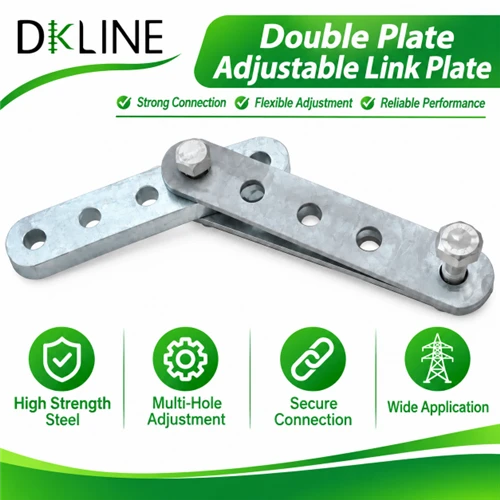
A PT Adjustment Plate is a type of power line fitting designed to provide flexible connection adjustments in overhead line assemblies. With multiple connection holes and a robust steel structure, it helps accommodate different installation requirements and simplifies the assembly of insulator string connections.
In this article, we will explore the structure, working principle, key functions, and applications of PT Adjustment Plates in overhead power line systems.
2. What Is a PT Adjustment Plate?
A PT Adjustment Plate is a connecting fitting used in overhead power transmission and distribution line hardware assemblies. It is generally installed between insulator strings and other connecting components to provide additional connection positions and adjustable assembly lengths.
Unlike a standard connecting plate with a fixed connection position, a PT Adjustment Plate typically features multiple holes arranged along its body. By selecting different holes during installation, workers can adjust the overall connection length to meet specific structural requirements.
This flexibility makes it useful in insulator string assemblies where accurate connection positioning and hardware compatibility are important.
3. Structure and Main Components of a PT Adjustment Plate
The PT Adjustment Plate is generally manufactured from high-strength steel to withstand mechanical loads in overhead line applications.
Its main structural features include:
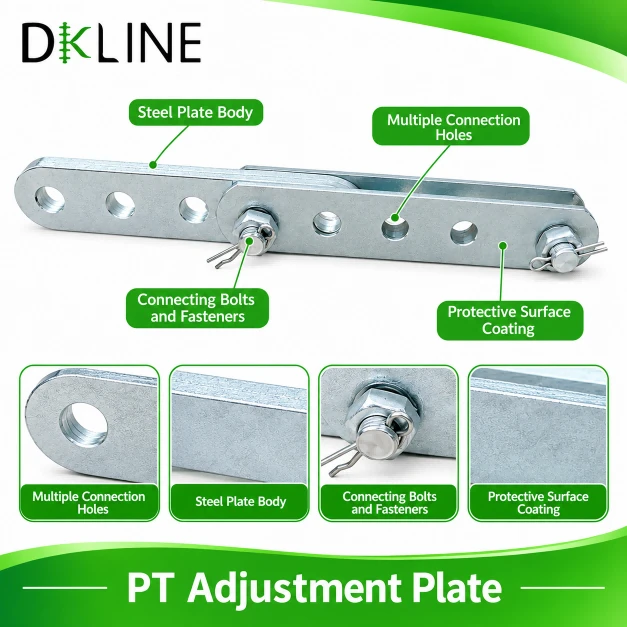
Multiple Connection Holes
Multiple holes provide different connection positions, allowing installers to select suitable mounting points and adjust the assembly length.
Steel Plate Body
The main body provides mechanical support and connects different hardware components. Its thickness and dimensions are designed according to the required mechanical strength.
Connecting Bolts and Fasteners
Bolts, nuts, and other fastening components secure the plate to adjacent fittings and help maintain a stable mechanical connection.
Protective Surface Coating
Hot-dip galvanizing is commonly used to improve corrosion resistance and protect the steel surface against outdoor environmental conditions.
4. How Does a PT Adjustment Plate Work?
The main working principle of a PT Adjustment Plate is based on selecting different connection positions to achieve the required assembly length.
During installation, the plate is connected to adjacent fittings using bolts or other compatible connecting hardware. Installers select the appropriate holes according to the required connection dimensions.
By changing the connection position, the effective distance between connected components can be adjusted within the available range of the plate.
This design provides several practical benefits:
Flexible Length Adjustment: Multiple holes provide different connection positions for adapting to installation requirements.
Improved Assembly Compatibility: Helps connect hardware components with different dimensional requirements.
Convenient Installation: Reduces the need for additional customized connecting parts in suitable applications.
Reliable Mechanical Connection: A properly selected and installed plate helps maintain a stable connection between insulator string components.
It is important to note that the adjustment is achieved during installation. The PT Adjustment Plate does not automatically change its length during line operation.
5. Applications of PT Adjustment Plates in Overhead Power Lines
PT Adjustment Plates are mainly used in overhead transmission and distribution line hardware assemblies where connection length adjustment is required.
Typical applications include:
Insulator String Connections
They can be used to connect insulator strings with other fittings, helping achieve suitable assembly dimensions and connection positions.
Overhead Line Hardware Assemblies
They provide additional connection positions in assemblies involving connecting plates, clevises, and other line fittings.
Transmission Tower Connections
In suitable tower configurations, PT Adjustment Plates can help accommodate dimensional differences between connecting components.
Line Construction and Maintenance
Their adjustable hole arrangement provides installation flexibility during new line construction, hardware replacement, and maintenance work.
6. PT Adjustment Plate vs. Standard Connecting Plate
Although both products are used to connect overhead line hardware, their structural designs and functions are different.
|
Comparison |
PT Adjustment Plate |
Standard Connecting Plate |
|
Main Function |
Connection and length adjustment |
Basic mechanical connection |
|
Hole Arrangement |
Multiple adjustment positions |
Generally fixed connection positions |
|
Installation Flexibility |
Higher adjustment flexibility |
Depends on fixed dimensions |
|
Typical Application |
Adjustable insulator string assemblies |
General hardware connections |
The appropriate product should be selected according to the required connection dimensions, mechanical loading conditions, and assembly design.
7. How to Select the Right PT Adjustment Plate?
Selecting a suitable PT Adjustment Plate is important for ensuring reliable connections in overhead line assemblies.
Consider the following factors before purchasing:
1. Mechanical Load Requirements
Check the required rated mechanical load and ensure that the selected fitting meets the design requirements of the line assembly.
2. Connection Dimensions
Confirm the plate length, width, thickness, hole diameter, and hole spacing to ensure compatibility with adjacent fittings.
3. Material and Surface Treatment
High-strength steel with hot-dip galvanizing is commonly used for outdoor applications because of its mechanical properties and corrosion resistance.
4. Installation Compatibility
Check the connecting bolt specifications and the dimensions of the adjacent insulator string fittings before installation.
5. Applicable Standards
Verify that the product design, material, manufacturing process, and mechanical performance comply with the relevant project specifications and applicable industry standards.
8. Why Choose DKLINE PT Adjustment Plates?
DKLINE provides power line hardware and connecting fittings for overhead transmission and distribution applications.Our PT Adjustment Plates are designed to support flexible hardware assembly and reliable mechanical connections.
Key product features include:
Robust steel construction for mechanical strength.
Multiple connection holes for flexible installation positioning.
Precision hole processing for improved assembly compatibility.
Protective surface treatment for outdoor service conditions.
Customizable dimensions and specifications according to project requirements.
Whether for new overhead line construction or existing line hardware replacement, DKLINE can provide suitable connecting hardware solutions based on your project requirements.
9. Conclusion
PT Adjustment Plates play a practical role in overhead power line hardware assemblies by providing flexible connection positions and adjustable assembly lengths.
When properly selected and installed, they help improve the compatibility of insulator string connections, simplify hardware assembly, and support reliable mechanical connections.
Choosing the right PT Adjustment Plate requires careful consideration of mechanical load requirements, connection dimensions, material quality, and installation conditions.